A surprising treat for people interesting in the connection between the history and the pedagogy of mathematics (HPM): The HPM Newsletter website has published a few articles which will be included in the March paper/pdf issue of the newsletter. This is the start of a new habit, in which we hope to publish new materials every month, to be collected in the paper/pdf version three times a year.
New on the website today is for instance an article on BSHM Bulletin number 3/2010, including a link to the full papers of that issue of the Bulletin.
Enjoy!
Showing posts with label history of mathematics. Show all posts
Showing posts with label history of mathematics. Show all posts
Tuesday, February 1, 2011

Wednesday, August 4, 2010
ESU6 Day 5
The last day of the ESU was also the shortest. I skipped the plenary lecture to secure more time for packing, checking out of the hotel and so on. The lecture I missed was Fulvia Furinghetti and Livia Giacardini’s “From Rome to Rome: Events, People, and Numbers during ICMI’s First Century”.
I did, however, take part in Snezana Lawrence’s workshop “Digitising the past mathematics by the future mathematicians”. It concerned how working on earlier textbooks may be interesting for today’s schoolkids. For instance, they may be interested to see that earlier textbooks (based on Euclid), actually gave definitions in a way that are almost gone now. Nowadays, textbooks give explanations with pictures and words, perhaps making it less clear what is the core definition and what is examples or illustrations. The workshop did not, however, give a very clear idea of what Snezana thinks that the role of “digitising” should be in this. While I do see that students could learn from scanning and transcribing short portions of text and then making it publicly available, I’m not convinced that it is worth the time. (And the other members of my group in this workshop was rather convinced it was not worth the time.) However, the work we did in the workshop was a good illustration of some of the points Michael Glaubitz made in his plenary lecture.

That marks the end of the conference. It was hard work. I leave the conference inspired and with a wish to continue working on history of mathematics. However, I also think that I was a bit too busy at this conference. In the end, I got to choose five of the workshops, but none of the oral presentations (I was always either speaking or being a chair). Having presentations on three of the days (one oral presentation, one workshop and one panel) is a bit too much also, both in the weeks ahead of the conference and in the conference itself.
I look forward to the HPM Meeting in Korea in 2012 and the ESU7 in Spain (maybe) in 2014.
I did, however, take part in Snezana Lawrence’s workshop “Digitising the past mathematics by the future mathematicians”. It concerned how working on earlier textbooks may be interesting for today’s schoolkids. For instance, they may be interested to see that earlier textbooks (based on Euclid), actually gave definitions in a way that are almost gone now. Nowadays, textbooks give explanations with pictures and words, perhaps making it less clear what is the core definition and what is examples or illustrations. The workshop did not, however, give a very clear idea of what Snezana thinks that the role of “digitising” should be in this. While I do see that students could learn from scanning and transcribing short portions of text and then making it publicly available, I’m not convinced that it is worth the time. (And the other members of my group in this workshop was rather convinced it was not worth the time.) However, the work we did in the workshop was a good illustration of some of the points Michael Glaubitz made in his plenary lecture.
That marks the end of the conference. It was hard work. I leave the conference inspired and with a wish to continue working on history of mathematics. However, I also think that I was a bit too busy at this conference. In the end, I got to choose five of the workshops, but none of the oral presentations (I was always either speaking or being a chair). Having presentations on three of the days (one oral presentation, one workshop and one panel) is a bit too much also, both in the weeks ahead of the conference and in the conference itself.
I look forward to the HPM Meeting in Korea in 2012 and the ESU7 in Spain (maybe) in 2014.
Sunday, August 1, 2010
ESU6 Day 4
Michael Glaubitz’ plenary lecture, which marked the start of the fourth day of the conference, was titled “The Use of Original Sources in the Classroom – Empirical Research Findings”. He set up a teaching experiment using original sources in two different ways: a genetic approach and a hermeneutic approach. Then he also had a “conventional” approach.
While a genetic approach is usually considered a means of introducing a topic (the pupils will meet the topic in the same order as it was developed in history), a hermeneutic approach (as suggested by Jahnke) concerns reading original sources when already having pre-knowledge about the topic concerned.
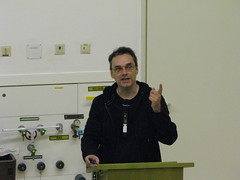

Glaubitz set up three teaching sequences of equal length which were then taught in different groups of students by different teachers. The genetic approach failed miserably, while the hermeneutic approach did significantly better than the conventional approach. Of course, such an experiment can never be a proof of the non-feasibility of an idea, so the results for the genetic approach are not the most interesting ones. However, it is a bit impressive that teachers used to the conventional approach can be guided into teaching successfully with original sources (using the hermeneutic approach) in such a short time. (Although we may of course, as always, have the effect of trying something new.)
To me, this is very promising results. The genetic approach seems too ambitious to me – in a way, you need to take into account all the history of mathematics at the same time, which puts enormous demands on the teachers’ knowledge. The hermeneutic approach delves into one particular point of time and one particular context. While that is certainly also demanding, it seems more like something many teachers could be willing to try – given the right materials.
The second plenary lecture was Raffaele Pisano’s “Which is the cultural and interdisciplinary role played by physical and mathematical sciences? Epistemological Reflections”. This talk concerned the connections between physics and mathematics. To be perfectly honest, I have never had a physics course in my life, and therefore found most of the lecture too advanced for me. (Which doesn’t say much, of course.)
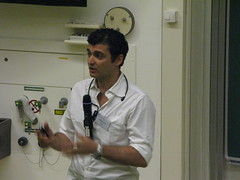
Then there was another panel. The title was “The role of the history and epistemology of mathematics in pre-service teachers training”. The panelists were Evelyne Barbin, Fulvia Furinghetti, Snezana Lawrence and myself. I did not take notes during this panel (except notes on what I was going to say), so I’m not the right person to try to summarize it. However, for me personally, the main outcome of the panel itself and the preparations for it was a realization that it is time that I do something a bit more substantial when it comes to making history of mathematics available to teachers. It’s been ten years since my first HPM conference (in which I complained about the quality of Norwegian textbooks), six years since my second HPM conference (and first ESU) (in which I complained about the quality and quantity of history of mathematics in the TIMSS Video Study materials), three years since my second ESU (in which I did not complain actually – but showed examples of history of mathematics I’ve used in teacher training) and two years since my third HPM (in which I discussed teachers’ conceptions of history of mathematics). Isn’t it time for me to come to a HPM or ESU with a textbook or webpage and discuss why I have created this wonderful book/webpage in this way? Maybe in 2014?
I could mention that my part of the panel discussion was taking Deborah Ball’s model of teacher competence in mathematics as a starting point. My own preparations on this – as well as a question in the discussion – made me realize that I have to revisit Ball’s articles to see what her (and her colleagues’) conception of “mathematics” is.
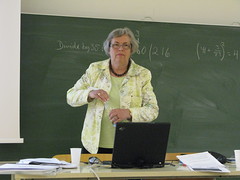
After lunch, I attended Kristín Bjarnadóttir’s workshop “Arithmetic textbooks in 18th century Icelandic manuscripts”. I think I would have found such a workshop painstakingly boring ten years ago, but I’ve grown to appreciate the study of textbooks as a valuable part of research on history of mathematics. Moreover, the kind of “detective work” that Kristín has been doing here and which she invited us to take part in in this workshop, is rather fascinating. Her object of study is an Icelandic manuscript, and she wants to find out as much as possible about which textbooks influenced it. The “detective work” consists partly in finding out which textbooks were known in Iceland at that time, and of comparing “her” text with these. From time to time, there are clear “hits”, when numerical examples are exactly the same in different textbooks – they must clearly have a common source.
In Norway, there has been published a book on the first Norwegian mathematics (arithmetic) textbook: Tyge Hanssøn’s “Arithmetica Danica” from 1645. While the author (Geir Botten) has done lots of work on this book, he has not done research on the influences of the textbook (as far as I know). It would surely be interesting to see the results of such a study at one point.
 coffee break area
The evening program was again oral presentations. Again, I was chairing (or cheering). There were three talks: Oscar Abdounur talked about the University of Sao Paulo, and how the invitation of European scholars to the university influenced it. Andreas Christiansen (whose name was terribly mispronounced by the chair – it’s a surprise that Christiansen (not Christensen) managed to speak after such an insult) spoke about Bernt Michael Holmboe’s textbooks and in particular how the concept of irrational number was presented in different editions, compared to how mathematicians elsewhere defined irrational numbers. Thirdly, Nuno Dias talked about the Portugese mathematics education, in particular after the Jesuits (who controlled Portugese education) were expelled in 1759.
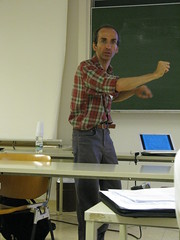

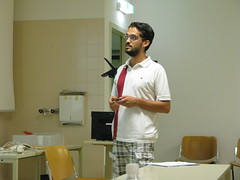
While a genetic approach is usually considered a means of introducing a topic (the pupils will meet the topic in the same order as it was developed in history), a hermeneutic approach (as suggested by Jahnke) concerns reading original sources when already having pre-knowledge about the topic concerned.
Glaubitz set up three teaching sequences of equal length which were then taught in different groups of students by different teachers. The genetic approach failed miserably, while the hermeneutic approach did significantly better than the conventional approach. Of course, such an experiment can never be a proof of the non-feasibility of an idea, so the results for the genetic approach are not the most interesting ones. However, it is a bit impressive that teachers used to the conventional approach can be guided into teaching successfully with original sources (using the hermeneutic approach) in such a short time. (Although we may of course, as always, have the effect of trying something new.)
To me, this is very promising results. The genetic approach seems too ambitious to me – in a way, you need to take into account all the history of mathematics at the same time, which puts enormous demands on the teachers’ knowledge. The hermeneutic approach delves into one particular point of time and one particular context. While that is certainly also demanding, it seems more like something many teachers could be willing to try – given the right materials.
The second plenary lecture was Raffaele Pisano’s “Which is the cultural and interdisciplinary role played by physical and mathematical sciences? Epistemological Reflections”. This talk concerned the connections between physics and mathematics. To be perfectly honest, I have never had a physics course in my life, and therefore found most of the lecture too advanced for me. (Which doesn’t say much, of course.)
Then there was another panel. The title was “The role of the history and epistemology of mathematics in pre-service teachers training”. The panelists were Evelyne Barbin, Fulvia Furinghetti, Snezana Lawrence and myself. I did not take notes during this panel (except notes on what I was going to say), so I’m not the right person to try to summarize it. However, for me personally, the main outcome of the panel itself and the preparations for it was a realization that it is time that I do something a bit more substantial when it comes to making history of mathematics available to teachers. It’s been ten years since my first HPM conference (in which I complained about the quality of Norwegian textbooks), six years since my second HPM conference (and first ESU) (in which I complained about the quality and quantity of history of mathematics in the TIMSS Video Study materials), three years since my second ESU (in which I did not complain actually – but showed examples of history of mathematics I’ve used in teacher training) and two years since my third HPM (in which I discussed teachers’ conceptions of history of mathematics). Isn’t it time for me to come to a HPM or ESU with a textbook or webpage and discuss why I have created this wonderful book/webpage in this way? Maybe in 2014?
I could mention that my part of the panel discussion was taking Deborah Ball’s model of teacher competence in mathematics as a starting point. My own preparations on this – as well as a question in the discussion – made me realize that I have to revisit Ball’s articles to see what her (and her colleagues’) conception of “mathematics” is.
After lunch, I attended Kristín Bjarnadóttir’s workshop “Arithmetic textbooks in 18th century Icelandic manuscripts”. I think I would have found such a workshop painstakingly boring ten years ago, but I’ve grown to appreciate the study of textbooks as a valuable part of research on history of mathematics. Moreover, the kind of “detective work” that Kristín has been doing here and which she invited us to take part in in this workshop, is rather fascinating. Her object of study is an Icelandic manuscript, and she wants to find out as much as possible about which textbooks influenced it. The “detective work” consists partly in finding out which textbooks were known in Iceland at that time, and of comparing “her” text with these. From time to time, there are clear “hits”, when numerical examples are exactly the same in different textbooks – they must clearly have a common source.
In Norway, there has been published a book on the first Norwegian mathematics (arithmetic) textbook: Tyge Hanssøn’s “Arithmetica Danica” from 1645. While the author (Geir Botten) has done lots of work on this book, he has not done research on the influences of the textbook (as far as I know). It would surely be interesting to see the results of such a study at one point.
coffee break areaThe evening program was again oral presentations. Again, I was chairing (or cheering). There were three talks: Oscar Abdounur talked about the University of Sao Paulo, and how the invitation of European scholars to the university influenced it. Andreas Christiansen (whose name was terribly mispronounced by the chair – it’s a surprise that Christiansen (not Christensen) managed to speak after such an insult) spoke about Bernt Michael Holmboe’s textbooks and in particular how the concept of irrational number was presented in different editions, compared to how mathematicians elsewhere defined irrational numbers. Thirdly, Nuno Dias talked about the Portugese mathematics education, in particular after the Jesuits (who controlled Portugese education) were expelled in 1759.
Tuesday, July 27, 2010
ESU6 Day 2
The second day of the ESU6 conference started with a plenary lecture by Michael N. Fried: “History of Mathematics in Mathematics Education: Problems and Prospects”.
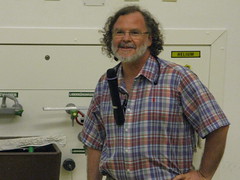
He first reminded us of the danger of a “Whig interpretation of history”, meaning, for instance “to praise revolutions provided they have been successful” (Butterfield). In history of mathematics, this often takes the form of showing how we got where we are today. The problem with this is, of course, that history is not about describing how we got where we are today, but to understand people of the past based on their own context. Fried gave the example of the idea of similarity in geometry, and claimed that while our concept of similarity is a “unified” concept based on transformations of the space, in Greek mathematics, there were separate definitions for different areas of use. For instance, if you wanted to define what it would mean for conic sections to be similar (as Apollonius did), you had to know something about conic sections and define similarity based on the pertinent attributes of the conic sections.
Thus, to teach the history of similarity, we will either have to take the students on a journey a bit longer than the way directly to transformations, or we will have to give a “Whig version” of the history.
So where should we put history of mathematics? That is a strange question, it’s as if history of mathematics is something outside mathematics. To the contrary, history of mathematics is an integral part of mathematics, and the more useful question would be “how do we design a curriculum consistent with a historical view”? (I’ll come back to this discussion when I write about Wednesday’s panel on textbooks.)
Then, Kostas Nikolantonakis and myself had a workshop on “Historical methods for multiplication”. Kostas discussed the method used by Eutocius of Ascalon in his commentary to “The measurement of the circle”. The participants were given the task of translating the numbers from the Greek alphabetic system to the modern numerals. Then we discussed the algorithm compared to the modern one and discussed the situation in schools today. One advantage of Eutocius’ method is that you write down all products in full, instead of having to move one to the left, writing some numbers below and some above and so on, as in the modern algorithm of multiplication.
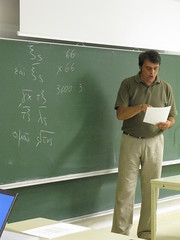
Greek algorithm to the left, a partial translation to the right
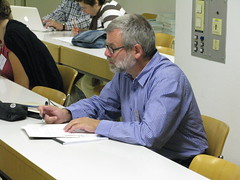
Participant concentrating on the translation
In the second part of the workshop, we discussed the method of “casting out nines”, based on a version of this found in Tyge Hanssøn’s “Arithmetica Danica” (discussed extensively in Geir Botten’s book which was published last year). An interesting insight I got from this is that there are actually two different ways of viewing this algorithms. I have always seen this as concerning “repeated digit sums” (“tverrsum” in Norwegian), where you take the sum of all the digits and then repeat until you have only one digit left. In other countries, as the name “casting out nines” suggest, they do not take the sum of all the digits, but rather remove nine whenever they get above nine. An example: 76292. I would find the repeated digit sum like this: 7+6+2+9+2=26. 2+6=8. Others would do it like this: 7+6=13, that leaves 4 after casting out the nine. 4+2=6. 6+9 = 15, which leaves 6. 6+2 = 8. The methods are obviously equivalent in their result, but feels a bit different.
Anyway, now I’m discussing what I learned from our workshop, not the contents of it. We went on to talk about the history of this method, and in the end spent some time discussing the role of different algorithms in teacher education. Here, I put Deborah Ball (etc)’s model on the wall and discussed that a little.
Then over to the day’s three-hour workshop. Man Keung Siu’s workshop was on “Inscribed square in a right triangle”. Yes, that’s right – we spent three hours inscribing squares in triangles (although not all of them right ones, actually). And I was exhausted afterwards, because the workshop involved so much thinking.
But first, before going on: given a right triangle ABC (where B is the right angle), how would you find a square DEFG such that D=B, E is on BC, F is on AC and G is on AB? (I must admit that at first I solved it using coordinates – which is quite a modern way, of course.)
The workshop was based on Chinese solutions of this problem, both before and after the influence of Euclid had come to China. The influence can be seen, as the proofs were changed significantly. However, I will refrain from trying to explain more about this here, as I would surely get lots of the facts wrong – not to mention the names of the Chinese mathematicians and texts.
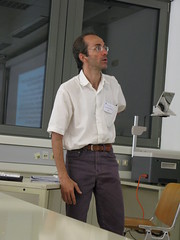
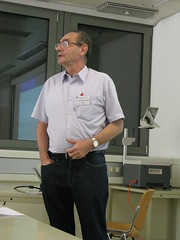
The last part of the day was again devoted to oral presentations. I was the chair of one of the sessions, a role which I choose to interpret as presenting the speaker and then keeping track of the time. With only 30 minutes, including questions and comments, for each speaker, I think they prefer the chair to be brief… The three speakers in this session was Gabriela Buendia Abalos, who talked about the use of the periodic property through history, and how it has evolved out of a need for prediction, Oscar Abdounur (stepping in for Adriane Cesar de Mattos) on a paper of George Boole and finally Gérard Grimberg, on the development of the geometric interpretation of complex numbers. Of course, I was interested to see which role Caspar Wessel’s work on complex numbers would get in this last talk, both because it was long overlooked and because it is – as Grimberg noted – not as much a geometric interpretation of complex numbers as a analytical representation of geometric objects. (Wessel’s background was in surveying, of course.)
That marked the end of the second day of the conference, one might imagine. No! There was a meeting at eight o’clock. The Advisory Board of the HPM (in which I am a member in my role as Newspaper editor) had a meeting/dinner. As usual in these meetings, it is a bit difficult for the people at one end of the table to hear what the people at the other end of the table say, so many of us were a bit curious as to what had been decided. I’m joking, of course – moreover, the Advisory Board does not decide things. The chair of the HPM makes decisions, after seeking advice in the Advisory Board.
An example of a topic discussed was whether the next HPM meeting (in Korea in 2012) should have its proceedings published before or after the conference. I think it was decided that they should be available before the conference. At my end of the table, we discussed whether it could then be called “proceedings”, and I proposed “preceedings”. Anyway, there are many advantages to having “preceedings”: for quality control, making it easier to find talks and workshops you’re interested in, making it possible to read contributions you can’t attend and then talk to the person at the conference instead of having to do that one year later. For many, the “preceedings” will not be the final publishing of the paper, as they will revisit the paper after the conference and then send an improved version to some journal or other.
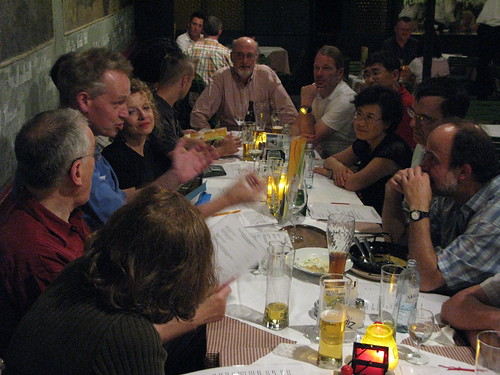
The food was delicious, by the way.
He first reminded us of the danger of a “Whig interpretation of history”, meaning, for instance “to praise revolutions provided they have been successful” (Butterfield). In history of mathematics, this often takes the form of showing how we got where we are today. The problem with this is, of course, that history is not about describing how we got where we are today, but to understand people of the past based on their own context. Fried gave the example of the idea of similarity in geometry, and claimed that while our concept of similarity is a “unified” concept based on transformations of the space, in Greek mathematics, there were separate definitions for different areas of use. For instance, if you wanted to define what it would mean for conic sections to be similar (as Apollonius did), you had to know something about conic sections and define similarity based on the pertinent attributes of the conic sections.
Thus, to teach the history of similarity, we will either have to take the students on a journey a bit longer than the way directly to transformations, or we will have to give a “Whig version” of the history.
So where should we put history of mathematics? That is a strange question, it’s as if history of mathematics is something outside mathematics. To the contrary, history of mathematics is an integral part of mathematics, and the more useful question would be “how do we design a curriculum consistent with a historical view”? (I’ll come back to this discussion when I write about Wednesday’s panel on textbooks.)
Then, Kostas Nikolantonakis and myself had a workshop on “Historical methods for multiplication”. Kostas discussed the method used by Eutocius of Ascalon in his commentary to “The measurement of the circle”. The participants were given the task of translating the numbers from the Greek alphabetic system to the modern numerals. Then we discussed the algorithm compared to the modern one and discussed the situation in schools today. One advantage of Eutocius’ method is that you write down all products in full, instead of having to move one to the left, writing some numbers below and some above and so on, as in the modern algorithm of multiplication.
Greek algorithm to the left, a partial translation to the right
Participant concentrating on the translation
In the second part of the workshop, we discussed the method of “casting out nines”, based on a version of this found in Tyge Hanssøn’s “Arithmetica Danica” (discussed extensively in Geir Botten’s book which was published last year). An interesting insight I got from this is that there are actually two different ways of viewing this algorithms. I have always seen this as concerning “repeated digit sums” (“tverrsum” in Norwegian), where you take the sum of all the digits and then repeat until you have only one digit left. In other countries, as the name “casting out nines” suggest, they do not take the sum of all the digits, but rather remove nine whenever they get above nine. An example: 76292. I would find the repeated digit sum like this: 7+6+2+9+2=26. 2+6=8. Others would do it like this: 7+6=13, that leaves 4 after casting out the nine. 4+2=6. 6+9 = 15, which leaves 6. 6+2 = 8. The methods are obviously equivalent in their result, but feels a bit different.
Anyway, now I’m discussing what I learned from our workshop, not the contents of it. We went on to talk about the history of this method, and in the end spent some time discussing the role of different algorithms in teacher education. Here, I put Deborah Ball (etc)’s model on the wall and discussed that a little.
Then over to the day’s three-hour workshop. Man Keung Siu’s workshop was on “Inscribed square in a right triangle”. Yes, that’s right – we spent three hours inscribing squares in triangles (although not all of them right ones, actually). And I was exhausted afterwards, because the workshop involved so much thinking.
But first, before going on: given a right triangle ABC (where B is the right angle), how would you find a square DEFG such that D=B, E is on BC, F is on AC and G is on AB? (I must admit that at first I solved it using coordinates – which is quite a modern way, of course.)
The workshop was based on Chinese solutions of this problem, both before and after the influence of Euclid had come to China. The influence can be seen, as the proofs were changed significantly. However, I will refrain from trying to explain more about this here, as I would surely get lots of the facts wrong – not to mention the names of the Chinese mathematicians and texts.
The last part of the day was again devoted to oral presentations. I was the chair of one of the sessions, a role which I choose to interpret as presenting the speaker and then keeping track of the time. With only 30 minutes, including questions and comments, for each speaker, I think they prefer the chair to be brief… The three speakers in this session was Gabriela Buendia Abalos, who talked about the use of the periodic property through history, and how it has evolved out of a need for prediction, Oscar Abdounur (stepping in for Adriane Cesar de Mattos) on a paper of George Boole and finally Gérard Grimberg, on the development of the geometric interpretation of complex numbers. Of course, I was interested to see which role Caspar Wessel’s work on complex numbers would get in this last talk, both because it was long overlooked and because it is – as Grimberg noted – not as much a geometric interpretation of complex numbers as a analytical representation of geometric objects. (Wessel’s background was in surveying, of course.)
That marked the end of the second day of the conference, one might imagine. No! There was a meeting at eight o’clock. The Advisory Board of the HPM (in which I am a member in my role as Newspaper editor) had a meeting/dinner. As usual in these meetings, it is a bit difficult for the people at one end of the table to hear what the people at the other end of the table say, so many of us were a bit curious as to what had been decided. I’m joking, of course – moreover, the Advisory Board does not decide things. The chair of the HPM makes decisions, after seeking advice in the Advisory Board.
An example of a topic discussed was whether the next HPM meeting (in Korea in 2012) should have its proceedings published before or after the conference. I think it was decided that they should be available before the conference. At my end of the table, we discussed whether it could then be called “proceedings”, and I proposed “preceedings”. Anyway, there are many advantages to having “preceedings”: for quality control, making it easier to find talks and workshops you’re interested in, making it possible to read contributions you can’t attend and then talk to the person at the conference instead of having to do that one year later. For many, the “preceedings” will not be the final publishing of the paper, as they will revisit the paper after the conference and then send an improved version to some journal or other.
The food was delicious, by the way.
Wednesday, July 21, 2010
ESU6 Day 1
I am currently attending the European Summer University on the History and Epistemology of Mathematics Education. The conference takes place in Vienna, Austria. As usual at such conferences, I will blog about what I learn from it.
The conference was opened by Mannfred Kronfeller, the main organisor of the conference, and by the Vice Rector of the Technical University of Vienna, Hans Kaiser.
The conference was opened by Mannfred Kronfeller, the main organisor of the conference, and by the Vice Rector of the Technical University of Vienna, Hans Kaiser.
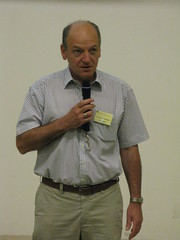
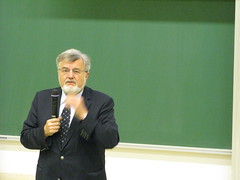
There were also short introductions by Evelyne Barbin, the chair of the HPM group, who outlined the history of the ESUs, and by Costas Tzanakis, who mentioned that representatives of 28 countries are present at the conference. That's not bad.
The first plenary speaker was Uffe Jankvist from Denmark. He talked about a teaching experiment that he has conducted (and which formed part of his PhD), where the history of mathematics played a major part. The topic was error-correcting codes and cryptography. But while this was the background of his talk, his real concern was to get more specific about what role history of mathematics can have in teaching. In particular, he studied whether he could see signs that the students would have meta-issue reflections on mathematics that were anchored in the mathematical in-issues that they were working on.
I find Uffe's approach very interesting. Instead of just claiming that "history of mathematics can make students reflect on the epistemology of mathematics", for instance, he sets out to study particular interpretations of this claim. It makes for a more nuanced and informed view of the part history of mathematics can play.
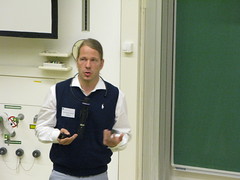
Uffe argues powerfully for the use of empirical studies (in this sense) in research on history of mathematics. I agree that this is one important path to follow. However, I believe that we still need the other paths as well. While studies such as this are convincing, they do too little to provide examples and materials for teachers to trz. For many teachers, successful attempts at including history of mathematics in their own classrooms are more powerful than researchers' results.
Then there was time for workshops. Workshops form a major part of the ESUs, as the ESU is supposed to give more "hands-on-experiences" than ordinary conferences. I attended Masami Isoda's workshop on how he has used the dbook software to create digital editions of textbooks with appended interactive materials. The example given was of historical instruments (from van Schooten's book). We were also given the chance of recreating the historical instruments by means of paper (see the wonderful instrument created by the group consisting of Jan van Maanen and me - I must admit that Jan did most of the work...)
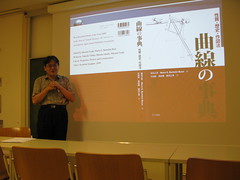
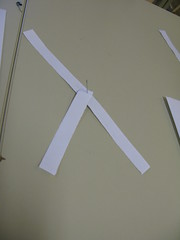
I think this is an interesting way of connecting the textbook with more interactive media.
Then I attended a three-hour workshop with Uffe Jankvist. There have been discussions during the conference of whether the three-hour format is too long. In my opinion, Uffe's workshop provides an existence proof that three hours may at times be about the right amount of time. Uffe wanted the participants to analyze some bits of transcripts with the same analytical tools that he had used in his PhD. In the beginning, the participants were quite hesistant, as both the mathematical and historical topic under consideration was unfamiliar and the analytical tools were new to us. However, by the end of the workshop, it seemed to me that everybody was participating in trying to find the "potential anchoring points" that Uffe was interested in.
As mentioned above, I think that there is great potential in getting more detailed concepts of how history of mathematics may be included in teaching, making it possible for teachers to be more conscious about exactly which effects they are trying to produce in a particular circumstance.
Oral presentations are not such a high priority at the ESUs, so on Monday they were taking place from 1830 to 2000 at night. Gerlinde Faustmann talked about "Classroom experiences with history of mathematics", following the path mentioned above of providing examples and ideas for teaching mathematics using history. Then I had my presentation on the Norwegian literature on history of mathematics, where I outlined several points of potential improvements. (I keep thinking I should write a book on the subject - but where is the time for it...) And finally, Po-Hung Liu discussed "the evolution of college students' epistemological views of mathematics in a history-based class". This was a combination of teaching ideas with a somewhat detailed look at what students did get out of it.
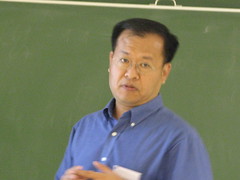
Of course, giving such a short summary of the first 11 hours of the conference does not allow for too many details. The proceedings of the conference will be available perhaps a year from now, so more details will be obtainable there...
I will continue with a discussion of day 2 in a later post.
Monday, July 12, 2010
European Summer University (ESU 6)
Next week, the European Summer University on the History and Epistemology in Mathematics Education (ESU6) will take place in Vienna. I will try to blog about it as it goes along, but thought I should start already...
The programme (available at the ESU6 website) has lots of interesting stuff, often with six events in parallell, so already it is time to lament all the good talks I will miss. However, such is life at big conferences. Here, I'll instead write about what I won't miss:
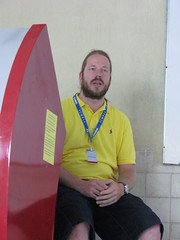
Uffe
The conference opens on Monday 19th of July. Uffe Jankvist will give the first plenary lecture, which seems to be based on his newly finished PhD (on historical modules in code theory). I will of course be attending this lecture. Afterwards, I will probably choose Masami Isoda's workshop on "Using historial instruments and interactive e-Textbook for experiencing the interpretation of historical textbooks" (although there are particularly many interesting workshops simultaneously). After lunsh, it seems reasonable to attend Uffe's three-hour workshop on "Students' meta-issue discussions of history of mathematics". As if that wasn't enough, there is an evening session of oral presentations, where Gerlinde Faustmann will talk about "Classroom experiences with history of mathematics", yours truly will talk about "History of mathematics in Norwegian - a literature review" (although the title in the program is "Making history of mathematics available to teachers - one page at a time"). And then Po-Hung Liu will speak about "Evolution of College Students' Eopistemological Views of Mathematics (...)". Then, finally, it's eight o'clock, and it's time to find a wiener schnitzel or something...
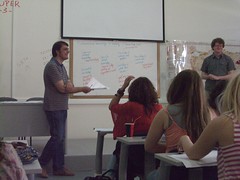
Kostas and me in Greece last year
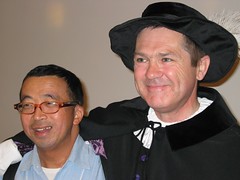
Man Keung Siu (with Peter Ransom)
Tuesday will begin with a plenary lecture by Michael N. Fried ("History of Mathematics in Mathematics Education: Problems and Prospects"). Right thereafter, Costas Nikolantonakis and yours truly will have a two-hour workshop on "Historical methods of multiplication". After lunch I will be relieved to be finished with the main part of my obligations at this conference. I will go to Man Keung Siu's three-hour workshop on "Inscribed square in a right triangle". Then, I'll have no choice, as I am the assigned chair of one of the sessions: I will chair three talks on "The use of periodic property through history (...)" (Gabriela Buendía Abalos), a study of a paper by George Boole (Adriana Cesar de Mattos) and "The geometric representation of complex numbers and education" (Gerard E. Grimberg). And as if that was not enough food for thought for one day, I will take part in the meeting of the HPM Advisory Board from 8 o'clock - hopefully accompanied with dinner.
Wednesday will feel like a day off after these 11 hour days. There will be a plenary lecture by Marc Moyon on "Practical Geometries in Islamic Countries" and a panel discussion on "The history of mathematics in school textbooks". The rest of the day is put aside for lunsh and excursions - as well as a cocktail reception in the evening.
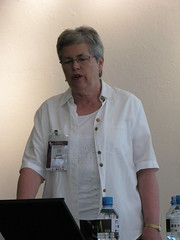
Kristín Bjarnadóttir
Then there's Thursday. Michael Glaubitz will give a plenary lecture on "The Use of Original Sources in the classroom - Empirical Research Findings". Michael was one of the editor of the proceedings from the Oberwolfach meeting on original sources some years ago, and it will be interesting to hear him again. The next plenary lecture, by Raffaele Pisano, will contain epistemological reflections on "the cultural and interdisciplinary role played by physical and mathematical sciences", according to the program. My mind will probably be with the next thing on the agenda: the panel discussion on "The role of the history and epistemology of mathematics in pre-service teachers training". I will be one of the participants of the panel, and this will also be my debut in the plenary of such a conference. After that - and lunch - I will attend Kristín Bjarnadóttir's three-hour workshop on "Arithmetic textbooks in 18th century Icelandic manuscripts". I last heard her at the HPM in Mexico City two years ago, and she is always interesting. And finally, I believe I'll listen to José Manuel Matos and Mária Almeida on "Shaping a modern mathematics pedagogical content knowledge: the case of Telescola in Portugal in the middle 1960s" as well as Catarina Mota's "The concept of tangent line: historical and didactical points in its teaching in Portugal".
Which leaves Friday. I may want to skip the plenary lecture on ICMI's first century, as I've heard Fulvia lecture on the topic before. Then I will probably choose Michael Glaubitz's workshop on "Teaching methods for the use of original sources in the classroom". Then I will consider if I want to hang around for the closing ceremony or if I should run to the train that will take me to holiday in Salzburg...
During the conference, I will also try to take lots and lots of photos - they tend to become useful in the context of the HPM Newsletter...
So that's my plans for next week. It will be fun. And interesting. And I will need the holiday afterwards...
(Update: Just for fun, a few days ago I had a look at what countries are participating in this conference. Here's the list:
Algeria (1)
Austria (9)
Belgium (3)
Brazil (9)
Canada (2)
China (1)
Cyprus (1)
Czech Republic (3)
Denmark (3)
France (18)
Germany (13)
Greece (14)
Hungary (1)
Iceland (1)
Iran (1)
Ireland (3)
Israel (5)
Italy (10)
Japan (2)
Morocco (1)
Mexico (2)
Netherlands (5)
Norway (2)
Poland (1)
Portugal (13)
Slovakia (4)
South Korea (2)
Spain (8)
Taiwan (1)
Uganda (1)
United Kingdom (2)
USA (3)
And then there are a few people who are on the programme but not on the list yet - such as the first plenary speaker...)
The programme (available at the ESU6 website) has lots of interesting stuff, often with six events in parallell, so already it is time to lament all the good talks I will miss. However, such is life at big conferences. Here, I'll instead write about what I won't miss:
Uffe
The conference opens on Monday 19th of July. Uffe Jankvist will give the first plenary lecture, which seems to be based on his newly finished PhD (on historical modules in code theory). I will of course be attending this lecture. Afterwards, I will probably choose Masami Isoda's workshop on "Using historial instruments and interactive e-Textbook for experiencing the interpretation of historical textbooks" (although there are particularly many interesting workshops simultaneously). After lunsh, it seems reasonable to attend Uffe's three-hour workshop on "Students' meta-issue discussions of history of mathematics". As if that wasn't enough, there is an evening session of oral presentations, where Gerlinde Faustmann will talk about "Classroom experiences with history of mathematics", yours truly will talk about "History of mathematics in Norwegian - a literature review" (although the title in the program is "Making history of mathematics available to teachers - one page at a time"). And then Po-Hung Liu will speak about "Evolution of College Students' Eopistemological Views of Mathematics (...)". Then, finally, it's eight o'clock, and it's time to find a wiener schnitzel or something...
Kostas and me in Greece last year
Man Keung Siu (with Peter Ransom)
Tuesday will begin with a plenary lecture by Michael N. Fried ("History of Mathematics in Mathematics Education: Problems and Prospects"). Right thereafter, Costas Nikolantonakis and yours truly will have a two-hour workshop on "Historical methods of multiplication". After lunch I will be relieved to be finished with the main part of my obligations at this conference. I will go to Man Keung Siu's three-hour workshop on "Inscribed square in a right triangle". Then, I'll have no choice, as I am the assigned chair of one of the sessions: I will chair three talks on "The use of periodic property through history (...)" (Gabriela Buendía Abalos), a study of a paper by George Boole (Adriana Cesar de Mattos) and "The geometric representation of complex numbers and education" (Gerard E. Grimberg). And as if that was not enough food for thought for one day, I will take part in the meeting of the HPM Advisory Board from 8 o'clock - hopefully accompanied with dinner.
Wednesday will feel like a day off after these 11 hour days. There will be a plenary lecture by Marc Moyon on "Practical Geometries in Islamic Countries" and a panel discussion on "The history of mathematics in school textbooks". The rest of the day is put aside for lunsh and excursions - as well as a cocktail reception in the evening.
Kristín Bjarnadóttir
Then there's Thursday. Michael Glaubitz will give a plenary lecture on "The Use of Original Sources in the classroom - Empirical Research Findings". Michael was one of the editor of the proceedings from the Oberwolfach meeting on original sources some years ago, and it will be interesting to hear him again. The next plenary lecture, by Raffaele Pisano, will contain epistemological reflections on "the cultural and interdisciplinary role played by physical and mathematical sciences", according to the program. My mind will probably be with the next thing on the agenda: the panel discussion on "The role of the history and epistemology of mathematics in pre-service teachers training". I will be one of the participants of the panel, and this will also be my debut in the plenary of such a conference. After that - and lunch - I will attend Kristín Bjarnadóttir's three-hour workshop on "Arithmetic textbooks in 18th century Icelandic manuscripts". I last heard her at the HPM in Mexico City two years ago, and she is always interesting. And finally, I believe I'll listen to José Manuel Matos and Mária Almeida on "Shaping a modern mathematics pedagogical content knowledge: the case of Telescola in Portugal in the middle 1960s" as well as Catarina Mota's "The concept of tangent line: historical and didactical points in its teaching in Portugal".
Which leaves Friday. I may want to skip the plenary lecture on ICMI's first century, as I've heard Fulvia lecture on the topic before. Then I will probably choose Michael Glaubitz's workshop on "Teaching methods for the use of original sources in the classroom". Then I will consider if I want to hang around for the closing ceremony or if I should run to the train that will take me to holiday in Salzburg...
During the conference, I will also try to take lots and lots of photos - they tend to become useful in the context of the HPM Newsletter...
So that's my plans for next week. It will be fun. And interesting. And I will need the holiday afterwards...
(Update: Just for fun, a few days ago I had a look at what countries are participating in this conference. Here's the list:
Algeria (1)
Austria (9)
Belgium (3)
Brazil (9)
Canada (2)
China (1)
Cyprus (1)
Czech Republic (3)
Denmark (3)
France (18)
Germany (13)
Greece (14)
Hungary (1)
Iceland (1)
Iran (1)
Ireland (3)
Israel (5)
Italy (10)
Japan (2)
Morocco (1)
Mexico (2)
Netherlands (5)
Norway (2)
Poland (1)
Portugal (13)
Slovakia (4)
South Korea (2)
Spain (8)
Taiwan (1)
Uganda (1)
United Kingdom (2)
USA (3)
And then there are a few people who are on the programme but not on the list yet - such as the first plenary speaker...)
Friday, July 9, 2010
Mathematics in school May 2010
I see that the May 2010 issue of Mathematics in school is devoted to history of mathematics. It includes articles by for instance Leo Rogers, Peter Ransom and Chris Weeks. Well worth a look...
Friday, September 11, 2009
PM's apology to codebreaker Alan Turing: we were inhumane
There's an interesting article in today's Guardian on a long overdue apology from the British government to gay mathematician Alan Turing, who committed suicide after being chemically castrated by the government.
The story of his life is a reminder of how mathematics can have an important role in society (in this case: in war) and how homophobia may blind people and governments even when faced with genius.
The story of his life is a reminder of how mathematics can have an important role in society (in this case: in war) and how homophobia may blind people and governments even when faced with genius.
Saturday, August 29, 2009
Article: Teachers' opinions about some teaching material involving history of mathematics
Barry J. Fraser and Anthony J. Koop: Teachers' opinions about some teaching material involving history of mathematics, International Journal of Mathematical education in science and technology (1978) 9: 147-151.
In this article, the authors describe research in which they have given 39 mathematics teachers access to two different kinds of teaching materials involving history of mathematics: a play about Thales and an article related to the history of conics. The teachers were asked to read the materials and then answer a questionnaire. I find this particularly interesting, because this could be seen as research on the teachers' attitudes - without the teachers being influenced by enthusiastic teacher-researchers.
Interestingly, teachers were quite positive to the materials, particularly the play. (A theory might be that a play is more instantly usable than an article?) However, a significant number of the teachers would nonetheless not use it in their own lessons. There are many who thinks that the play would take too much time, for instance.
Also interestingly, almost all teachers agreed that "materials like this are not readily available elsewhere". Of course, that situation has changed a bit since 1978, but it is still an obstacle to teachers' use of history of mathematics.
In this article, the authors describe research in which they have given 39 mathematics teachers access to two different kinds of teaching materials involving history of mathematics: a play about Thales and an article related to the history of conics. The teachers were asked to read the materials and then answer a questionnaire. I find this particularly interesting, because this could be seen as research on the teachers' attitudes - without the teachers being influenced by enthusiastic teacher-researchers.
Interestingly, teachers were quite positive to the materials, particularly the play. (A theory might be that a play is more instantly usable than an article?) However, a significant number of the teachers would nonetheless not use it in their own lessons. There are many who thinks that the play would take too much time, for instance.
Also interestingly, almost all teachers agreed that "materials like this are not readily available elsewhere". Of course, that situation has changed a bit since 1978, but it is still an obstacle to teachers' use of history of mathematics.
Sunday, August 23, 2009
Article: Didactics and History of Mathematics: Knowledge and Self-Knowledge
Michael N. Fried: Didactics and History of Mathematics: Knowledge and Self-Knowledge, Educational studies in mathematics (2007) 66: 202-223.
How to include history of mathematics in mathematics education in a way that is true to the history? This is an old question in the HPM community, and it is not resolved.
In this article, the author looks to Saussure and the theory of semiotics to argue that history of mathematics has an essential role to play in mathematics education. "The historian's and the working mathematician's ways of knowing are complementary."
First, he discusses what is the problem: "If, in the working mathematician's view, the otherness of a historical text is something illusory or merely superficial, the historical point of view is precisely the opposite. From tihs latter pole, a mathematical text is a cultural product, the product of a particular human being or group of human beings living in a particular time."
He gives a short (and welcome) introduction to Saussure, and describes two ways of knowing: synchronic and diachronic. Seen at one single point of time (synchronic), a language (or mathematics) seems static, and you can not see the social forces at play. When you look at a period of time (diachronic), you see how language (or mathematics) is evolving and ever-changing.
The author then gives an example: How Apollonius of Perga's Conics has been interpreted in different ways. Heath wrote that "[Apollonius'] method does not essentially differ from that of modern analytical geometry except that in Apollonius geometrical operations take the place of algebraic calculations" - an interpretation based squarely in the modern mathematics. The author of the article shows how Apollonius could rather give us an alternative way of viewing conics, which makes us more aware of our own modern view.
So what about mathematics education. The author argues that the object of mathematics education should not be only to learn mathematical methods, but "our self-knowledge as mathematical beings". As such, the history is essential to give another perspective and let us learn more about our own views.
How to include history of mathematics in mathematics education in a way that is true to the history? This is an old question in the HPM community, and it is not resolved.
In this article, the author looks to Saussure and the theory of semiotics to argue that history of mathematics has an essential role to play in mathematics education. "The historian's and the working mathematician's ways of knowing are complementary."
First, he discusses what is the problem: "If, in the working mathematician's view, the otherness of a historical text is something illusory or merely superficial, the historical point of view is precisely the opposite. From tihs latter pole, a mathematical text is a cultural product, the product of a particular human being or group of human beings living in a particular time."
He gives a short (and welcome) introduction to Saussure, and describes two ways of knowing: synchronic and diachronic. Seen at one single point of time (synchronic), a language (or mathematics) seems static, and you can not see the social forces at play. When you look at a period of time (diachronic), you see how language (or mathematics) is evolving and ever-changing.
The author then gives an example: How Apollonius of Perga's Conics has been interpreted in different ways. Heath wrote that "[Apollonius'] method does not essentially differ from that of modern analytical geometry except that in Apollonius geometrical operations take the place of algebraic calculations" - an interpretation based squarely in the modern mathematics. The author of the article shows how Apollonius could rather give us an alternative way of viewing conics, which makes us more aware of our own modern view.
So what about mathematics education. The author argues that the object of mathematics education should not be only to learn mathematical methods, but "our self-knowledge as mathematical beings". As such, the history is essential to give another perspective and let us learn more about our own views.
Thursday, August 20, 2009
Article: On the argument of simplicity in Elements and schoolbooks of Geometry
Evelyne Barbin: On the argument of simplicity in Elements and schoolbooks of Geometry, Educational studies in mathematics (2007) 66: 225-242.
We all want to present the mathematics in a simple way to our students, don't we? Sure we do, but what do we mean by "simple" exactly? In this article, the author very interestingly traces the concept of "simplicity" through several editions of Euclid's Elements as well as in some recent French textbooks. And it turns out that "simplicity" is not as simple as we thought...
Proclus, in his commentary to Euclid, proposed two "orders of simplicity": simplicity of a figure and simplicity of theorems. "A figure is more complex than another if it is obtained from the former with additions of lines or circles." A theorem is simpler than another if it comes earlier in the order of logical deduction.
Peletier preferred clearness of proofs rather than simplicity of figures.
Arnauld sought to follow the "natural order". "It is contrary to this natural order to prove, as Euclid does, propositions on perpendicular straight lines or on parallel straight lines (simple things) using triangles (compound things)." Therefore, the whole book was ordered according to the natural order. A consequence of this was that "perpendicular lines [were] studied without using angles and angles [were] studied without using triangles."
Hoüel wanted simplicity of "principles and proofs". He defined "the straight line by the motion of a point, and the plane by the motion of a straight line. Angles are defined by the ideas of motion and direction." (I find this last point particularly interesting, as it has been a problem in Norwegian textbooks that angles have been defined as static things only, without any dynamic dimension.)
Then, of course, in the 20th century, the notion of sets was regarded as "the simplest of all the notions." This had absurd consequences; "In the Mathématiques, classe de sixième, directed by Mauguin (1977), for eleven-year old pupils, the angle is defined as an equivalence class."
Finally, in a textbook from 1996, the angle is introduced with drawings of fans which are opened to different degrees. This quite good idea is however partly destroyed by a confusing use of colors.
I have just given a tiny idea of the contents of the article, of course. The author shows how these different ideas of simplicity is determining the structure of the books. Choose your notion of simplicity, and the structure will have to change. She ends with a reference to Descartes:
We all want to present the mathematics in a simple way to our students, don't we? Sure we do, but what do we mean by "simple" exactly? In this article, the author very interestingly traces the concept of "simplicity" through several editions of Euclid's Elements as well as in some recent French textbooks. And it turns out that "simplicity" is not as simple as we thought...
Proclus, in his commentary to Euclid, proposed two "orders of simplicity": simplicity of a figure and simplicity of theorems. "A figure is more complex than another if it is obtained from the former with additions of lines or circles." A theorem is simpler than another if it comes earlier in the order of logical deduction.
Peletier preferred clearness of proofs rather than simplicity of figures.
Arnauld sought to follow the "natural order". "It is contrary to this natural order to prove, as Euclid does, propositions on perpendicular straight lines or on parallel straight lines (simple things) using triangles (compound things)." Therefore, the whole book was ordered according to the natural order. A consequence of this was that "perpendicular lines [were] studied without using angles and angles [were] studied without using triangles."
Hoüel wanted simplicity of "principles and proofs". He defined "the straight line by the motion of a point, and the plane by the motion of a straight line. Angles are defined by the ideas of motion and direction." (I find this last point particularly interesting, as it has been a problem in Norwegian textbooks that angles have been defined as static things only, without any dynamic dimension.)
Then, of course, in the 20th century, the notion of sets was regarded as "the simplest of all the notions." This had absurd consequences; "In the Mathématiques, classe de sixième, directed by Mauguin (1977), for eleven-year old pupils, the angle is defined as an equivalence class."
Finally, in a textbook from 1996, the angle is introduced with drawings of fans which are opened to different degrees. This quite good idea is however partly destroyed by a confusing use of colors.
I have just given a tiny idea of the contents of the article, of course. The author shows how these different ideas of simplicity is determining the structure of the books. Choose your notion of simplicity, and the structure will have to change. She ends with a reference to Descartes:
"As Descartes writes, arithmetic and geometry are more certain than the other sciences because their object is "so pure and so simple". [...] History of mathematics invites us to come back and to work with the notion of simplicity to construct the teaching of geometry."
Monday, August 17, 2009
Article: Mathematical history, philosophy and education
Michael Otte: Mathematical history, philosophy and education, Educational studies in mathematics (2007) 66: 243-255.
Combining history and philosophy of mathematics, this is not an easy read, and I will not claim to have grasped even the main points in the first reading.
It does start out with describing a point of view (which the author of this article does not share): "Within this context, it is frequently claimed, by mathematicians in particular, that mathematics has no history worth knowing. The newest state of the art of mathematics has taken up and reformulated in modern terms whatever appeared as worthwhile during its history."
By looking at some topics from the history of mathematics, he ends up in this conclusion: "Mathematical ideas that appear extremely abstract and difficult at first sight become understandable from a historical perspective only. The transformation of processes into structures with which we have dealt here is quite instructive in this respect. History of mathematics occupies itself describing processes of growth and development, whereas philosophy of mathematics is concerned with questions of justification. Both play an essential role within the educational context."
On the way from the beginning to the conclusion, the author looks at the view of numbers throughout history as well as the theory of integration from Cauchy to Lebesgue. The second of these was particularly interesting to me. Topology was one of my favorite courses in university, and it is interesting to see the development of topology from this perspective.
Combining history and philosophy of mathematics, this is not an easy read, and I will not claim to have grasped even the main points in the first reading.
It does start out with describing a point of view (which the author of this article does not share): "Within this context, it is frequently claimed, by mathematicians in particular, that mathematics has no history worth knowing. The newest state of the art of mathematics has taken up and reformulated in modern terms whatever appeared as worthwhile during its history."
By looking at some topics from the history of mathematics, he ends up in this conclusion: "Mathematical ideas that appear extremely abstract and difficult at first sight become understandable from a historical perspective only. The transformation of processes into structures with which we have dealt here is quite instructive in this respect. History of mathematics occupies itself describing processes of growth and development, whereas philosophy of mathematics is concerned with questions of justification. Both play an essential role within the educational context."
On the way from the beginning to the conclusion, the author looks at the view of numbers throughout history as well as the theory of integration from Cauchy to Lebesgue. The second of these was particularly interesting to me. Topology was one of my favorite courses in university, and it is interesting to see the development of topology from this perspective.
Friday, August 14, 2009
Article: The roles of Mesopotamian bronze age mathematics tool...
Jens Høyrup: The roles of Mesopotamian bronze age mathematics tool for state formation and administration - carrier of teachers' professional intellectual autonomy, Educational studies in mathematics (2007) 66: 111-129.
It is a privilege to read this article by Høyrup, no doubt based on insights gained through decades of studies. If you want a very short introduction to Mesopotamian mathematics, this is a good place to start.
He tells of how tokens were placed in clay containers for accounting purposes, that later impressions were made on the surface to make it possible to "read" the information without breaking the containers, and how even later, the tokens themselves were dropped, no longer being of any significance. He describes the notation developed.
Later, mathematics developed as a means of ensuring "just measure" (and the author is quick to point out that mathematical justice can also be cruel).
From Shuruppak (-2600), examples of school texts have been found. An example of an "exercise": "A silo containing 40x60 gur ('tuns') of grain, each of 8x60 sila ('litres') is distributed in portions of 7 sila per worker." The answer is 164,571 workers, with a remainder of 3 sila, but the numbers included are surely not from a practical situation. (Already at that time, unrealistic numbers were used in mathematics exercises...)
In 2074, an administrative reform were carried out bringing my thoughts to harsh central planning regimes such as Mao's China or North Korea. Workers were organized in troups, and the overseers were responsible for their unit's performance, with preset goals (read the details in the article). Mathematics was necessary to keep the system running.
The author spends some time on the text "BM 13901". The translation goes as the following:
The explanation (in geometrical terms) is fascinating.
It is a remarkable article with insights I will make sure to bring to my classrooms.
It is a privilege to read this article by Høyrup, no doubt based on insights gained through decades of studies. If you want a very short introduction to Mesopotamian mathematics, this is a good place to start.
He tells of how tokens were placed in clay containers for accounting purposes, that later impressions were made on the surface to make it possible to "read" the information without breaking the containers, and how even later, the tokens themselves were dropped, no longer being of any significance. He describes the notation developed.
Later, mathematics developed as a means of ensuring "just measure" (and the author is quick to point out that mathematical justice can also be cruel).
From Shuruppak (-2600), examples of school texts have been found. An example of an "exercise": "A silo containing 40x60 gur ('tuns') of grain, each of 8x60 sila ('litres') is distributed in portions of 7 sila per worker." The answer is 164,571 workers, with a remainder of 3 sila, but the numbers included are surely not from a practical situation. (Already at that time, unrealistic numbers were used in mathematics exercises...)
In 2074, an administrative reform were carried out bringing my thoughts to harsh central planning regimes such as Mao's China or North Korea. Workers were organized in troups, and the overseers were responsible for their unit's performance, with preset goals (read the details in the article). Mathematics was necessary to keep the system running.
The author spends some time on the text "BM 13901". The translation goes as the following:
I have heaped the surface and my confrontation: it is 3/4. 1 the projection you posit, half-part of 1 you break, make 1/2 and 1/2 hold, 1/4 and 3/4 you join: alongside 1, 1 is equilateral. 1/2 which you have made hold from the body of 1 you tear out: 1/2 is the confrontation.
The explanation (in geometrical terms) is fascinating.
It is a remarkable article with insights I will make sure to bring to my classrooms.
Wednesday, August 12, 2009
Article: Introduction: The topos of meaning or the encounter between past and present
Luis Radford, Fulvia Furinghetti and Victor Katz: Introduction: The topos of meaning or the encounter between past and present, Educational studies in mathematics (2007) 66: 111-129.
This article works as a foreword for the special issue. In addition to outlining the contents of the issue, it also argues for the role of history of mathematics in mathematics education.
"Learning by doing" is a well-known slogan in modern pedagogy, and extreme constructivists will argue that a pupil will have to construct all knowledge on his experiences. (I'm not saying that Dewey himself had this view.) The authors quote Leontiev, who said that
The authors continue: "The very possibility of learning rests in our capability of immersing ourselves - in idiosyncratic, critical and reflective ways - in the conceptual historical riches deposited in, and continuously modified by, social practices."
And studying the history of mathematics is one way of being immersed in this while asking questions we might not ask when we are faced with modern methods.
This article works as a foreword for the special issue. In addition to outlining the contents of the issue, it also argues for the role of history of mathematics in mathematics education.
"Learning by doing" is a well-known slogan in modern pedagogy, and extreme constructivists will argue that a pupil will have to construct all knowledge on his experiences. (I'm not saying that Dewey himself had this view.) The authors quote Leontiev, who said that
"No one's personal experience, no matter how rich it might be, can result in thinking logically, abstractly and mathematically, and in individually establishing a system of ideas. To do this, one would need not just one lifetime, but thousands."
The authors continue: "The very possibility of learning rests in our capability of immersing ourselves - in idiosyncratic, critical and reflective ways - in the conceptual historical riches deposited in, and continuously modified by, social practices."
And studying the history of mathematics is one way of being immersed in this while asking questions we might not ask when we are faced with modern methods.
Sunday, August 9, 2009
Article: Learning to listen: from historical sources to classroom practice
Abraham Arcavi and Masami Isoda: Learning to listen: from historical sources to classroom practice, Educational studies in mathematics (2007) 66: 111-129.
For prospective teachers, it is important to learn to listen to their students. There are several challenges to this, however, and the main idea of this article is that maybe prospective teachers can learn to listen by "listening" to historical texts. As when listening to students, "listening" to a historical text involves taking another person's perspective. The historical text, however, has a certain authority that makes it harder to ignore - while teachers may ignore students' attempts and instead just teach them "the right way".
The authors make a distinction between "evaluative listening" and "attentive listening". I surely recognize this distinction - at times, I will notice that I'm not exactly listening to what the student is saying, instead I'm listening FOR something particular. I'm waiting for the student to say what I want to hear instead of trying to make sense of what he is actually saying. In teaching based on constructivism, of course attentive listening is necessary.
The particular examples of history of mathematics that the authors used in their teaching, are from Egyptian mathematics, for instance the Egyptian method of multiplication. I agree that this is a good example to use (see also an earlier post on this (in Norwegian).
I also agree with the authors that as well as a collection of good ideas for use in teacher education, we also need good examples of students' work as a next step in "learning to listen", after working on the history of mathematics.
For prospective teachers, it is important to learn to listen to their students. There are several challenges to this, however, and the main idea of this article is that maybe prospective teachers can learn to listen by "listening" to historical texts. As when listening to students, "listening" to a historical text involves taking another person's perspective. The historical text, however, has a certain authority that makes it harder to ignore - while teachers may ignore students' attempts and instead just teach them "the right way".
The authors make a distinction between "evaluative listening" and "attentive listening". I surely recognize this distinction - at times, I will notice that I'm not exactly listening to what the student is saying, instead I'm listening FOR something particular. I'm waiting for the student to say what I want to hear instead of trying to make sense of what he is actually saying. In teaching based on constructivism, of course attentive listening is necessary.
The particular examples of history of mathematics that the authors used in their teaching, are from Egyptian mathematics, for instance the Egyptian method of multiplication. I agree that this is a good example to use (see also an earlier post on this (in Norwegian).
I also agree with the authors that as well as a collection of good ideas for use in teacher education, we also need good examples of students' work as a next step in "learning to listen", after working on the history of mathematics.
Thursday, August 6, 2009
Article: Teacher education through the history of mathematics
Fulvia Furinghetti: Teacher education through the history of mathematics, Educational studies in mathematics (2007) 66: 131-143.
Teacher students have a tendency to reproduce the teaching styles that they have themselves experienced when they were pupils. And then, when they start in their first job as teachers, they will have a tendency to learn from their older colleagues. These two tendencies have a conservative effect on teaching.
In this article, the author discusses how history of mathematics can be a part of teacher education in a way that will work against the first tendency mentioned above. "Prospective teachers need a context allowing them to look at the topics they will teach in a different manner", she argues.
The history of mathematics was not taught as a goal in itself, but rather as "a mediator of knowledge for teaching". The students had "difficulties in considering ways of teaching a given mathematical topic other than the way that they have seen it in their school days", but by working on a teaching segment on algebra and the history of algebra in that context, they were helped to find new ways.
Teacher students have a tendency to reproduce the teaching styles that they have themselves experienced when they were pupils. And then, when they start in their first job as teachers, they will have a tendency to learn from their older colleagues. These two tendencies have a conservative effect on teaching.
In this article, the author discusses how history of mathematics can be a part of teacher education in a way that will work against the first tendency mentioned above. "Prospective teachers need a context allowing them to look at the topics they will teach in a different manner", she argues.
The history of mathematics was not taught as a goal in itself, but rather as "a mediator of knowledge for teaching". The students had "difficulties in considering ways of teaching a given mathematical topic other than the way that they have seen it in their school days", but by working on a teaching segment on algebra and the history of algebra in that context, they were helped to find new ways.
Monday, August 3, 2009
Article: Stages in the History of Algebra with Implications for Teaching
Victor J. Katz (with Bill Barton): Stages in the History of Algebra with Implications for Teaching, Educational studies in mathematics (2007) 66: 185-201.
In this article, Victor Katz gives "highlights" from the history of algebra. He does not spend time on the well-known three stages in the expression of algebra: the rhetorical stage, the syncopated stage, and the symbolic stage. Instead, he looks at four conceptual stages: the geometric stage, the static equation-solving stage, the dynamic function stage and the abstract stage.
The by far most long-lasting of these stages (so far) was the geometric stage. Euclid's algebra was geometrical, but so was Babylonian algebra from about 4000 years ago. Al-Khwarizmi (about 825) still justified the methods by geometrical means, but the reader was supposed to learn the algorithm without needing recourse to the geometry. For Katz, Al-Khwarizmi marks the move to the sttatic equation-solving stage.
Although Sharaf al-Din (died 1213) were using methods that could have been the start of the dynamic function stage, it instead had to wait until the early 1600s to take hold. With Fermat and Descartes, and later Newton, algebra moved from being mostly concerned with solving equations to be a method for determining curves, for instance.
Then, during the 1800s mathematicians worked on more general concepts, such as the group (Galois and Cayley are important names in that development).
Katz asks whether these stages should have pedagogical implications. Should geometric figures play a bigger part in the beginning of work on algebra? Should we work more on equations before introducing functions? And so on.
As usual, there are no easy answers when it comes to pedagogical issues, but at least it seems a good idea to know the history before designing the teaching of the future.
In this article, Victor Katz gives "highlights" from the history of algebra. He does not spend time on the well-known three stages in the expression of algebra: the rhetorical stage, the syncopated stage, and the symbolic stage. Instead, he looks at four conceptual stages: the geometric stage, the static equation-solving stage, the dynamic function stage and the abstract stage.
The by far most long-lasting of these stages (so far) was the geometric stage. Euclid's algebra was geometrical, but so was Babylonian algebra from about 4000 years ago. Al-Khwarizmi (about 825) still justified the methods by geometrical means, but the reader was supposed to learn the algorithm without needing recourse to the geometry. For Katz, Al-Khwarizmi marks the move to the sttatic equation-solving stage.
Although Sharaf al-Din (died 1213) were using methods that could have been the start of the dynamic function stage, it instead had to wait until the early 1600s to take hold. With Fermat and Descartes, and later Newton, algebra moved from being mostly concerned with solving equations to be a method for determining curves, for instance.
Then, during the 1800s mathematicians worked on more general concepts, such as the group (Galois and Cayley are important names in that development).
Katz asks whether these stages should have pedagogical implications. Should geometric figures play a bigger part in the beginning of work on algebra? Should we work more on equations before introducing functions? And so on.
As usual, there are no easy answers when it comes to pedagogical issues, but at least it seems a good idea to know the history before designing the teaching of the future.
Friday, July 31, 2009
Article: The notion of historical "parallelism" revisited: historical evolution and students' conception of the order relation on the number line
Yannis Thomaidis and Constantinos Tzanakis: The notion of historical "parallelism" revisited: historical evolution and students' conception of the order relation on the number line, Educational studies in mathematics (2007) 66: 165-183.
This article combines historical study with classroom study, to examine the "relation between historical evolution of mathematical concepts and the process of their teaching and learning". They wanted to look at both whether there is a "parallelism" here and what such a parallel "between a creative mathematician of the past and a student learning mathematics in a modern classromm" might consist of.
The mathematical topic considered is the order relation on the number line - that is (for instance); is -4 greater than or smaller than -2? In section 2 of the article, the authors trace the development of mathematicians' thought on this. For instance, Newton wrote that "the greatest negative [root]" was the one "most remote [from zero]", that is -4 > -2. Also, Bolzano used the notation e<±1 for which we would write -1< e< 1.
The study of students posed three questions, of which the first one was:
"What are the solutions of the inequality x² > 9 when x ∈ ℜ?"
Lots of interesting answers were given to the questions. For instance, it did turn out that some students had the same basic ideas as Newton and Bolzano mentioned above.
The authors argue that there are parallelisms that could be exploited to
Reason enough to include history of mathematics in teacher education, in my opinion...
This article combines historical study with classroom study, to examine the "relation between historical evolution of mathematical concepts and the process of their teaching and learning". They wanted to look at both whether there is a "parallelism" here and what such a parallel "between a creative mathematician of the past and a student learning mathematics in a modern classromm" might consist of.
The mathematical topic considered is the order relation on the number line - that is (for instance); is -4 greater than or smaller than -2? In section 2 of the article, the authors trace the development of mathematicians' thought on this. For instance, Newton wrote that "the greatest negative [root]" was the one "most remote [from zero]", that is -4 > -2. Also, Bolzano used the notation e<±1 for which we would write -1< e< 1.
The study of students posed three questions, of which the first one was:
"What are the solutions of the inequality x² > 9 when x ∈ ℜ?"
Lots of interesting answers were given to the questions. For instance, it did turn out that some students had the same basic ideas as Newton and Bolzano mentioned above.
The authors argue that there are parallelisms that could be exploited to
"forsee possible persistent difficulties of the students; and to make teachers more tolerant towards their students' errors, by increasing their awareness that these errors and difficulties do not simply mean that "the student has not studied enough" but may have deeper epistemological roots which should be explored and understood thoroughly."but also
"become more tolerant towards non-conventional, but essentially correct, views of their students, even though they may be wrong or insufficient by modern standards of logical rigor and clarity; [...] encourage these and other students to express their possibly idiosyncratic views on specific mathematical problems and in this way to implicitly guide them towards conceiving mathematics as an exciting human activity".
Reason enough to include history of mathematics in teacher education, in my opinion...
Wednesday, July 29, 2009
Article: Syntax and Meaning as Sensuous, Visual, Historical forms of Algebraic Thinking
Issue number 2 of Educational studies in mathematics 2007 was a special issue on history of mathematics. For some reason, I haven't read it in full before, but now is as good a time as any. In the following days I will blog about the articles in this special issue.
Luis Radford and Luis Puig: Syntax and Meaning as Sensuous, Visual, Historical forms of Algebraic Thinking, Educational studies in mathematics (2007) 66: 145-164.
There are a few main concepts in this article, and by pointing to these, I will give an idea of what the article is about:
The Embedment Principle: "our cognitive mechanisms (e.g. perceiving, abstracting, symbolizing) are related, in a crucial manner, to a historical conceptual dimension ineluctably embedded in our social practices and in the signs and artifacts that mediate them."
Zones of proximal development of the culture: "new mathematical ideas are answers worked out in the historically situated zones of proximal development of their cultures".
The authors argue that "phylogenesis cannot recapitulate ontogenesis". "To learn algebra is not to construct the objects of knowledge (for they have already been constructed) but to make sense of them."
The article goes on to look at how this can be explored in an 8th grade class' work on fractional equations. The authors look at a word problem, in which students successfully writes the algebraic equation. In this form, the students recognize every part of the equation as a representation of a corresponding part of the word problem. However, when trying to solve the equation, the correspondence with the word problem is lost, and the operations take over as the "main personages".
This is an interesting point which I will try to keep in mind next time I teach equations.
The point about learners not "constructing" the objects of knowledge ("for they have already been constructed") is not entirely convincing to me, however. Why not "construct anew"? I agree that when students learn algebra, they do not on their own construct the objects of knowledge from nothing, but the word "construct" still makes sense to me. Or maybe I would prefer to think of it as a combination - partly (re)constructing and partly making sense?
(Obviously, I need to think more about this...)
Luis Radford and Luis Puig: Syntax and Meaning as Sensuous, Visual, Historical forms of Algebraic Thinking, Educational studies in mathematics (2007) 66: 145-164.
There are a few main concepts in this article, and by pointing to these, I will give an idea of what the article is about:
The Embedment Principle: "our cognitive mechanisms (e.g. perceiving, abstracting, symbolizing) are related, in a crucial manner, to a historical conceptual dimension ineluctably embedded in our social practices and in the signs and artifacts that mediate them."
Zones of proximal development of the culture: "new mathematical ideas are answers worked out in the historically situated zones of proximal development of their cultures".
The authors argue that "phylogenesis cannot recapitulate ontogenesis". "To learn algebra is not to construct the objects of knowledge (for they have already been constructed) but to make sense of them."
The article goes on to look at how this can be explored in an 8th grade class' work on fractional equations. The authors look at a word problem, in which students successfully writes the algebraic equation. In this form, the students recognize every part of the equation as a representation of a corresponding part of the word problem. However, when trying to solve the equation, the correspondence with the word problem is lost, and the operations take over as the "main personages".
This is an interesting point which I will try to keep in mind next time I teach equations.
The point about learners not "constructing" the objects of knowledge ("for they have already been constructed") is not entirely convincing to me, however. Why not "construct anew"? I agree that when students learn algebra, they do not on their own construct the objects of knowledge from nothing, but the word "construct" still makes sense to me. Or maybe I would prefer to think of it as a combination - partly (re)constructing and partly making sense?
(Obviously, I need to think more about this...)
Friday, June 26, 2009
HPM Newsletter 71
The new issue of the HPM Newsletter (no. 71) was published today. It is available from the HPM website.
In this issue:
- a note on Giorgio T. Bagni, an Italian colleague who tragically died earlier this month
- information on new books: Geir Botten's book on the first Norwegian textbook in mathematics and three books related to Paulus Gerdes' work
- the first announcement for the ESU 6, which will be in Vienna, Austria 19th-23rd of July 2010
- information on how Narges Assarzadegan uses history of mathematics in her work
- a call for possible collaboration on history of mathematics for primary school students.
In addition, there are the usual stuff (information on new articles in the field, interesting links and announcements of events).
In this issue:
- a note on Giorgio T. Bagni, an Italian colleague who tragically died earlier this month
- information on new books: Geir Botten's book on the first Norwegian textbook in mathematics and three books related to Paulus Gerdes' work
- the first announcement for the ESU 6, which will be in Vienna, Austria 19th-23rd of July 2010
- information on how Narges Assarzadegan uses history of mathematics in her work
- a call for possible collaboration on history of mathematics for primary school students.
In addition, there are the usual stuff (information on new articles in the field, interesting links and announcements of events).
Subscribe to:
Posts (Atom)

 Posts
Posts


